No. 005December 15, 2025 · 8 min read
What the Postcard Kept
A famous birch, a famous rock, and the small towns that printed themselves into history.
There is a window of about thirty years, from the late 1880s to roughly 1920, when most of the New Hampshire that exists in old people's memories is also the New Hampshire that got photographed for the first time. The window has a name. The photochrom era.
Most prints from this era are postcards, the kind that fit in a coat pocket and arrived for a penny postage. A few are larger photochroms, hand-tinted lithographs from a Swiss process that the Detroit Publishing Company licensed for the United States in the 1890s. The two formats together, postcard and photochrom, did most of the work of selling New Hampshire to itself and to anyone east of the Hudson who could afford a vacation.
The window matters to a wood turner because it is also the first generation of printed images showing a forest the workshop's wood is descended from. The trees in these pictures are a hundred and twenty years older now. Almost none of them are still standing. The wood that comes through this shop is, in some cases, the wood of those trees' grandchildren.
I. The wizard
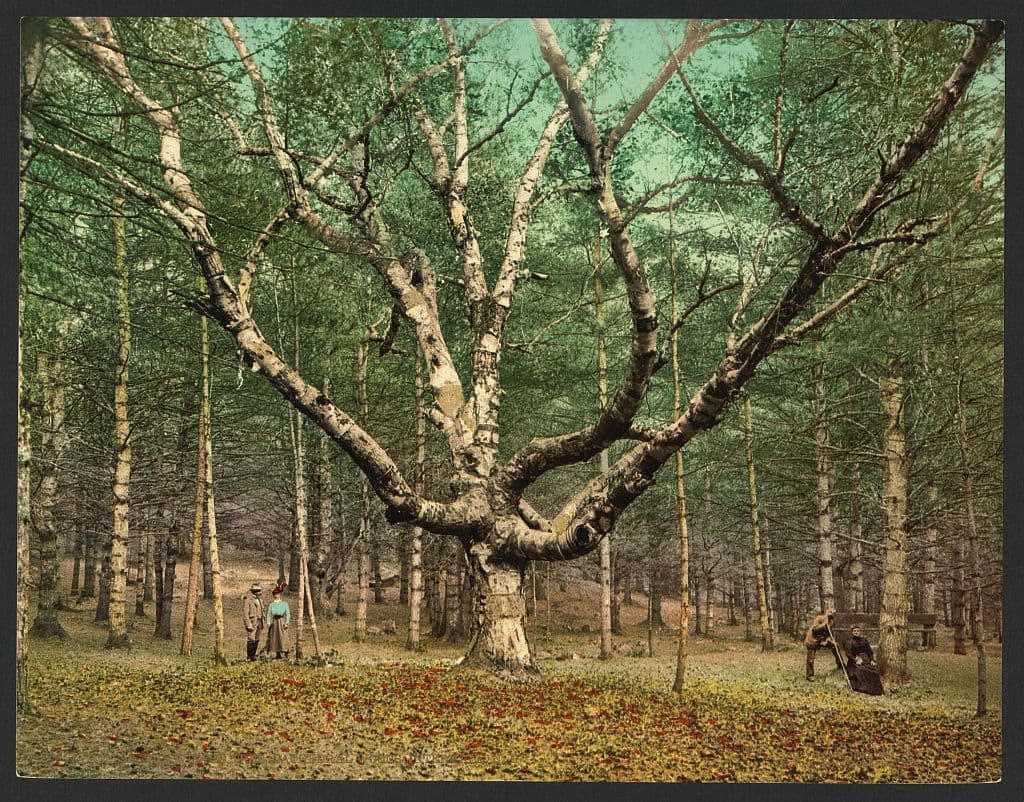
The photograph at the top of this post is the most famous tree in the White Mountains that nobody alive ever saw. It was a white birch in Intervale, in a stretch of woods called Cathedral Woods near the Saco River valley. Its proper name on the photochrom is The Wizard Tree, after a nineteenth-century photograph by Nathaniel Paine that captioned it White Birch Tree (The Wizard). It was known to local children well before then. Paine gave it the name that stuck.
The tree was an oddity. The birches around it grew the way New Hampshire birches usually grow: tall, straight, papery, leaning toward the light. The Wizard grew the other way. Its trunk turned, branched, twisted around itself, and threw out arms that came back down to within reach of the ground. A grown person could stand under one of its lower branches without ducking. Children climbed the lower limbs without help. People came from Boston to be photographed under it.
The print was made in 1900 by the Detroit Photographic Company, the Michigan firm that had bought the exclusive North American rights to the Swiss process called Photochrom. Photochrom worked by transferring a black-and-white negative onto a series of lithographic stones, one for each color the operator could approximate by eye. A skilled colorist could produce something that read, to a viewer of 1900, as photographic color, decades before color photography existed. The firm renamed itself the Detroit Publishing Company in 1905, kept its license through the postcard boom, and went into receivership in 1924.
The Wizard Tree itself fell in the late 1940s. Cathedral Woods is still walked. The tree is a print on a wall now.
II. The rock with a profile
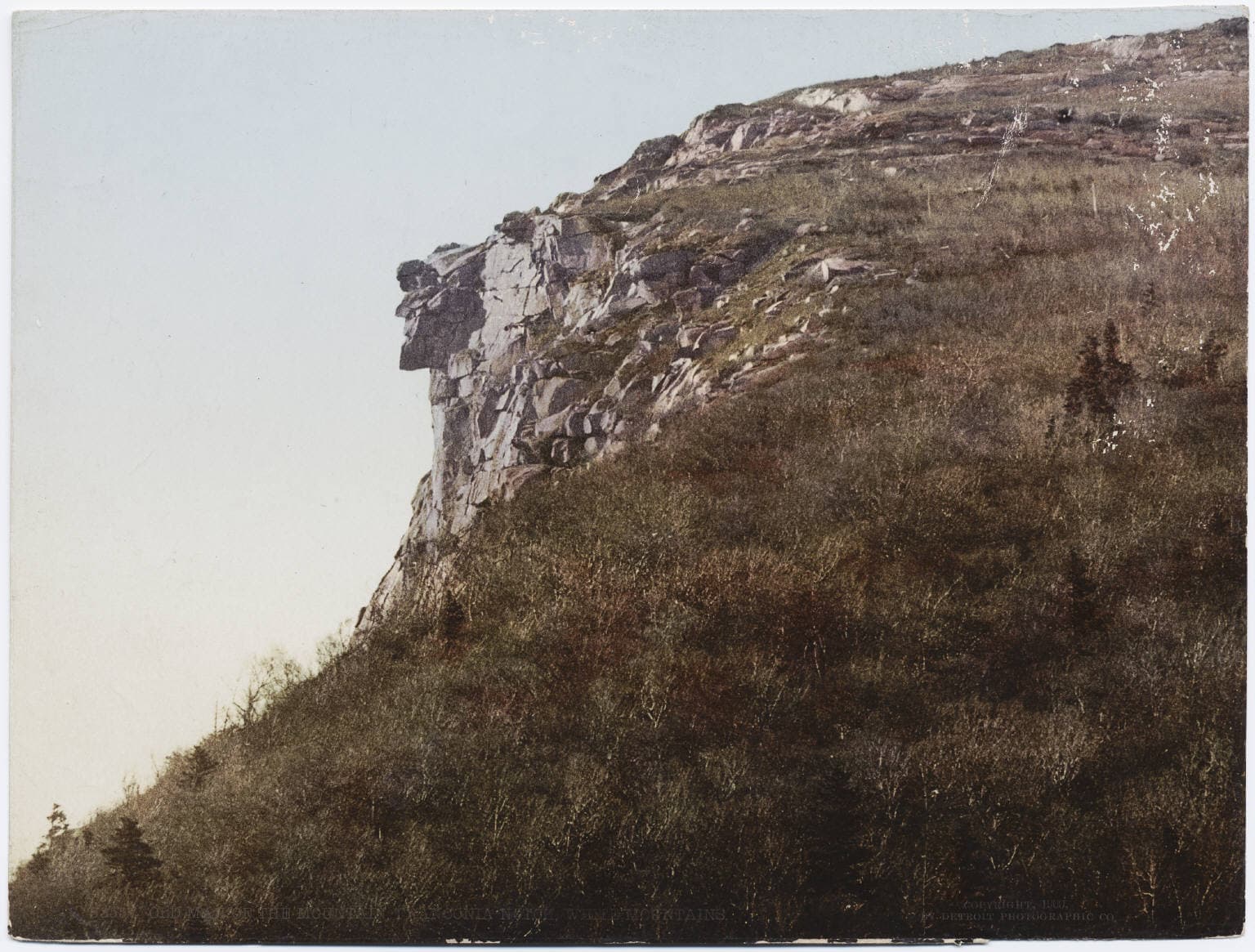
The other thing the photochrom era kept that has not survived in the world is the Old Man of the Mountain. The Old Man was a granite formation on Cannon Mountain in Franconia Notch, a profile of a face that the right viewing angle assembled from five separate ledges, twelve hundred feet above Profile Lake. He was the state's emblem, on the route signs, the highway maps, and the back of the New Hampshire quarter. He fell on the night of May 2 to 3, 2003.
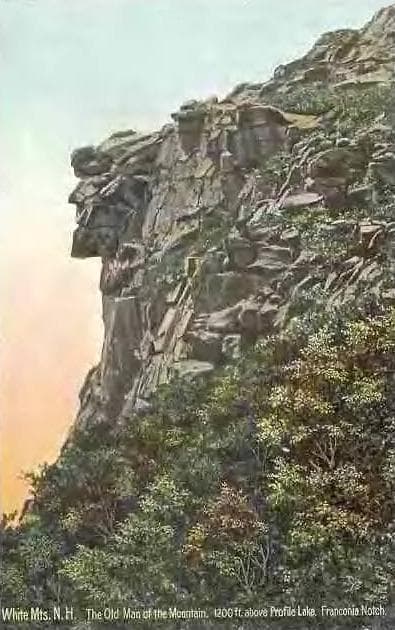
Two prints of the Old Man are shown above. The first is the Detroit Publishing photochrom from around 1900, the painterly hand-tinted version. The second is a postcard from about a decade later, mass-printed in color, with a caption strip across the bottom: White Mts., N.H. The Old Man of the Mountain. 1200 ft above Profile Lake. Franconia Notch. The same face, the same ledges, the same cliff. The first is a small piece of the state's pictorial history. The second is the version most New Hampshire households actually owned.
III. The towns arrange themselves
The thing the postcard era actually did most often, more often than the famous rock or the famous tree, was print the small towns themselves. Every village wanted a postcard set: the high school, the courthouse, the main street, the library, the trolley. The town's pride was on the page, mailed out a penny at a time, kept in a kitchen drawer for decades.
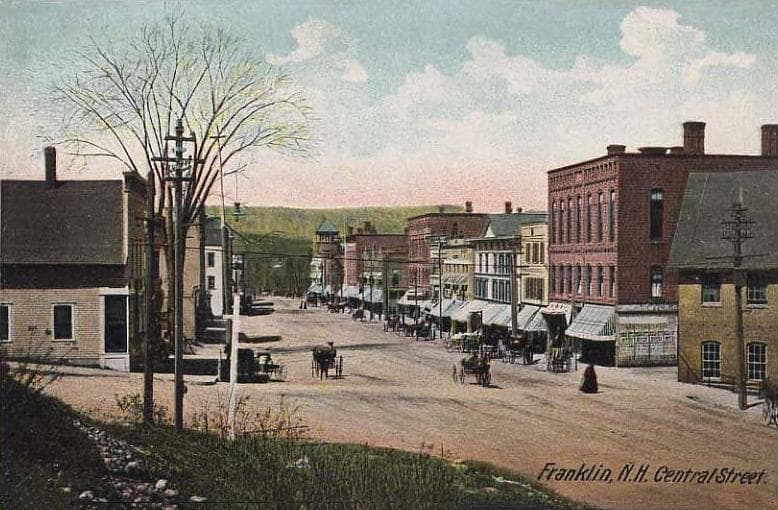
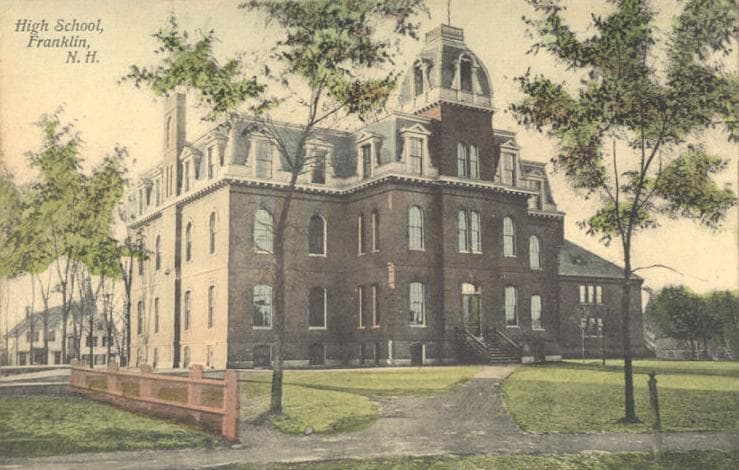
Franklin, at the southern edge of the Lakes Region, was the subject of at least two postcards from the era. One shows Central Street, the downtown's brick blocks lining a wide street with awnings and a single horse cart still in the picture. The other shows the old high school, a Second Empire brick building with a mansard roof and a small bell tower, the kind of school that existed in every New Hampshire mill town of any size. The school is gone. The buildings on Central Street, mostly, are still there.
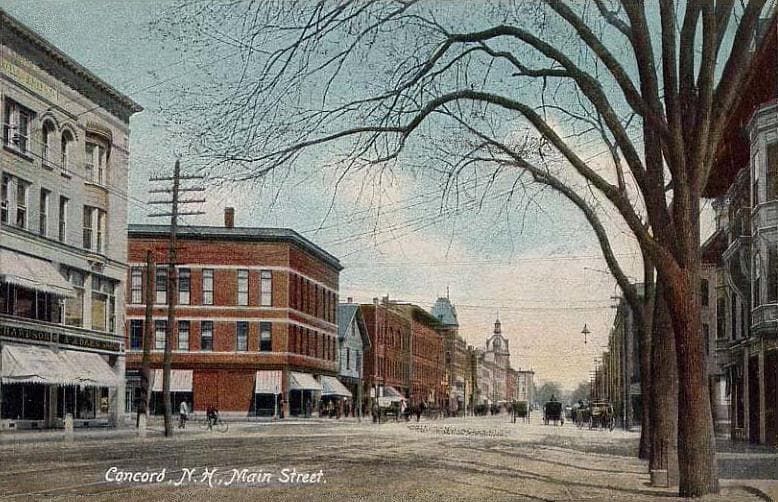
Concord's Main Street postcard is the same idea at the state-capital scale. A wide street, brick blocks, a single bare elm reaching across the foreground. Concord's elms came down with the rest of the country's elms during the Dutch elm disease wave of the mid-twentieth century. The buildings stayed.
IV. The working scene
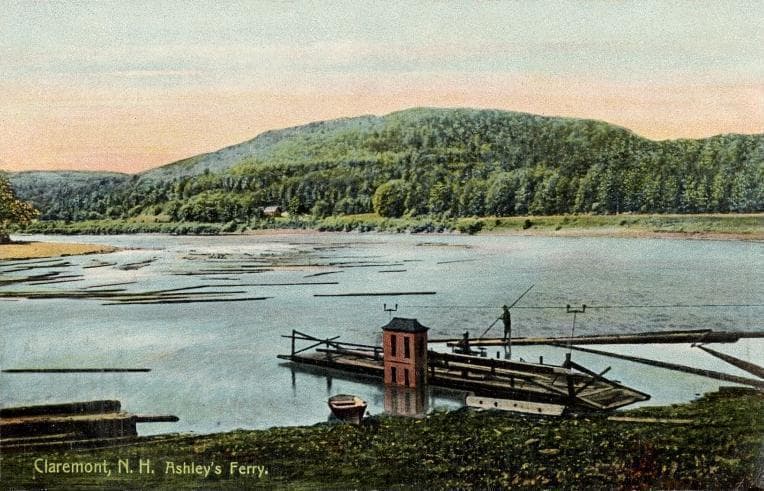
Not every postcard was a poseable view. Claremont's Ashley's Ferry shows a small wooden ferry on the Connecticut River, a working scene with logs in the water and a man standing on the deck handling a long pole. Samuel Ashley was given a charter to run a ferry across the Connecticut at this site in 1784. The ferry continued in some form into the early twentieth century. The bridges came later. What the postcard preserves is one of the last commercial moments of a river that had been a working highway for more than a hundred years.
V. What the postcard kept
The Wizard Tree is gone. The Old Man is gone. The Franklin high school is gone. The Concord elms are gone. The ferry is gone. Most of the trees these prints were made among are gone. What is still here is the wood, in its grandchildren generation. A bowl turned in the shop today might be a hundred years downstream from a tree that grew in the field just behind the photographer in any one of these images.
There is a tendency to read these old prints as nostalgia. They might be read differently. They are not loss. They are the record of what the second forest grew up beside. The work of the lathe is, in some small way, a continuation of the act of paying attention the photographer was performing when he set up the tripod under a birch in 1900.
The image is the start of the chain. The wood is the rest of it.
From this writingThe bench
See the pieces it
points to.
Every wood in this post is on the bench right now. Birch, maple, cherry burl, walnut, beech, and white pine.
Browse the bench