No. 004January 22, 2026 · 8 min read
Green vs. Dry
Why a bowl is turned twice, six months apart.
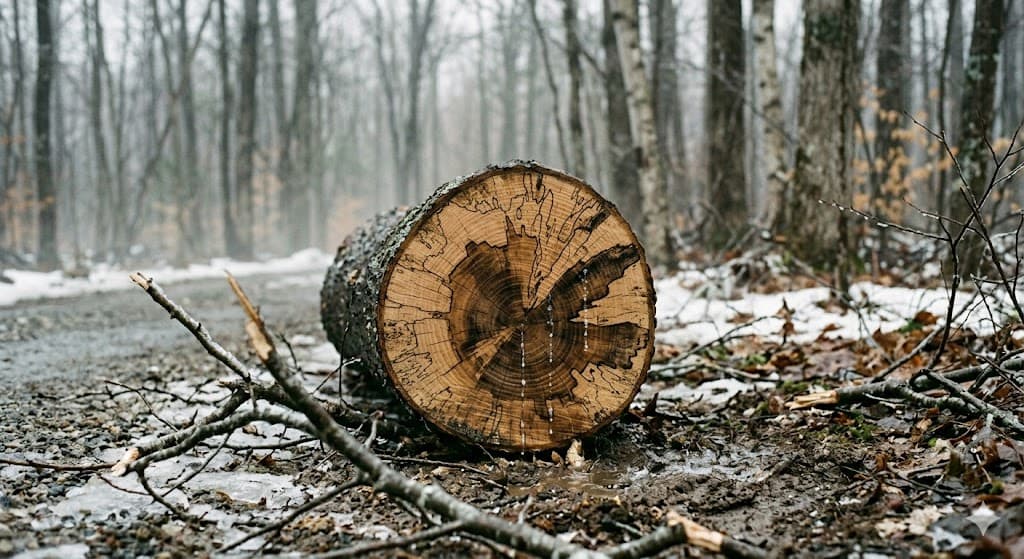
A freshly cut log is two-thirds water. A finished bowl is one-tenth water. Most of the work between them is waiting.
Wood is a wet material. In a living tree, the trunk is a column of water moving up to the leaves, and the moisture content of the wood — measured against its bone-dry weight — runs anywhere from forty percent in a slow oak to over a hundred percent in a sugar maple in spring sap. Bring that same wood down to the equilibrium of a heated New Hampshire kitchen, and the moisture content settles around six to eight percent. A bowl made wrong loses that water in the wrong order, in the wrong place, and cracks.
Why a bowl warps
Wood does not shrink the same in every direction. The numbers, for most northeastern hardwoods, run something like this: along the grain — fractions of a percent. Across the rings, radially — around four percent. Around the rings, tangentially — eight to ten percent. The tangential dimension shrinks roughly twice as much as the radial. That difference is why a flat board cups, why a log splits as it dries, and why a bowl turned green and then dried will go from round to oval. The oval is not a flaw. It is the wood telling the truth about how it is built.
A turner has two choices, and both are valid.
The two-turn method
The traditional approach is to rough-turn the bowl while the wood is still wet, walls thick — somewhere between a tenth and a twelfth of the diameter. The rough-turned bowl goes into a paper bag of its own shavings, or onto a slow shelf in a barn, or through a low-temperature dehumidifier kiln. Six to twelve months later it is dry, slightly out of round, and ready for a second turning that brings it back to true. The walls come down to a quarter inch, a sixteenth, a millimeter at the rim. The bowl is finished as if it had been turned dry, because by the second cut it has been.
This shop runs mostly that way. A rough-turned wall of cherry might sit on the second-floor rack of an unheated barn from October to May, losing a few grams of water a week, settling into the shape it wants. By spring it has moved a half inch out of round and a quarter inch in height. The second turning takes an afternoon and twenty years of patience, in equal measure.
The once-turned bowl
The other approach, championed in the late twentieth century by turners like David Ellsworth and Mike Mahoney, is to turn the bowl wet to its final wall thickness — a quarter inch or less, often less — and let it move as it dries. The result is a bowl that is alive on the shelf, oval where it was round, undulating at the rim. The aesthetic is honest: the wood was wet, the wood dried, the bowl shows what happened. A once-turned bowl is faster to make and slower to make beautifully. A round bowl forgives a careless cut. An oval one does not.
“A bowl turned green and dried slowly is a record of a year's weather as much as a year's work.”
Sealers, cracks, and the long wait
End grain dries faster than face grain, and an unsealed log will check from the ends within hours of being cut. The standard answer is a wax emulsion — Anchorseal is the brand most often cited — brushed on the end grain of every blank as soon as it comes off the saw. A roughed bowl gets a thinner coat on the rim and the foot. The wax slows the loss of water from the end grain to roughly the rate of the side grain, and the wood dries evenly enough not to split.
- Fast methods. Microwaving in short bursts, boiling, low-temperature kilns, dehumidifier kilns. All work; all cost something. Microwaving makes a small piece of wood smell like a wet dog. Boiling can dull the figure of cherry. Kilns are unforgiving of overcrowding.
- Slow methods. Paper bags of shavings. Open shelves in a cool, dry barn. Plastic-wrapped blanks rotated weekly. The slowest is also the safest.
- Failure modes. End checks, surface checks, ring shake, honeycomb. Almost all of them come from drying too fast.
The patience is the part of this work that does not photograph. A bowl is a five-hour job and a six-month job at the same time. The tree took a hundred years to grow the wood. The turner can afford the next half year.
From this writingThe bench
See the pieces it
points to.
Every wood in this post is on the bench right now. Birch, maple, cherry burl, walnut, beech, and white pine.
Browse the bench